
White Bear Lake City Directory Collections
No verified, continuous White Bear Lake-only directory run was located in the public catalog material. The strongest confirmed leads are regional publications that include White Bear Lake, plus the local history collections that supply the names, addresses, and dates needed to use them well. Start with the collection that fits the year in question. Then ask the holding library whether it has a missing edition, a reel, or a related telephone book before treating a catalog gap as a dead end.
| Collection | Years | Where Held | Access |
|---|---|---|---|
| R.L. Polk's St. Paul and Ramsey County City Directory | 1950 verified | University of Minnesota and Google Books | Digitized volume with searchable text |
| St. Paul North Suburban city-directory reels | 1958-1960 | Minnesota Historical Society Gale Family Library | Ask for the reel or a directory-search request |
| WBLAHS newspaper and genealogy files | 1887-2005 microfilm; 1887-1988 index | White Bear Lake Area Historical Society | Online index plus appointment research |
| WBLAHS census and address-reference files | 1860-1930 census sets; 1980s renumbering | WBLAHS Online Research | Online spreadsheets and reference-library follow-up |
The absence of a verified city-only run matters. A White Bear Lake search may sit under St. Paul, Ramsey County, North Suburban, White Bear Township, or a nearby community label. Minnesota Historical Society offers a city-directory and telephone-book search request, while the White Bear Lake Area Historical Society, known as WBLAHS, can help identify a local collection or needed year. Neither source supports assuming annual White Bear Lake issues or assuming every volume includes a reverse section.
Polk and North Suburban Directory Years
The verified R.L. Polk lead is a 1950 St. Paul and Ramsey County city directory. Its searchable text includes White Bear Lake coverage. A Gale index also identifies St. Paul North Suburban reels from 1958 through 1960 that include White Bear Lake among their suburban communities. These are regional tools, not proof of a stand-alone White Bear Lake publishing series.
The digitized Polk volume shows why it is useful: entries sit in dense, narrow alphabetical columns, with street or area headings helping the reader move through the scan. Read the volume itself before expanding an abbreviation. A line can give a name, residence address, relationship or spouse clue, occupation shorthand, business reference, room or corner notation, or a widow convention. Those details help distinguish similar names, but their exact punctuation and meanings can vary by edition.
The digitized 1950 Polk directory is a useful starting view for White Bear Lake city directory research.
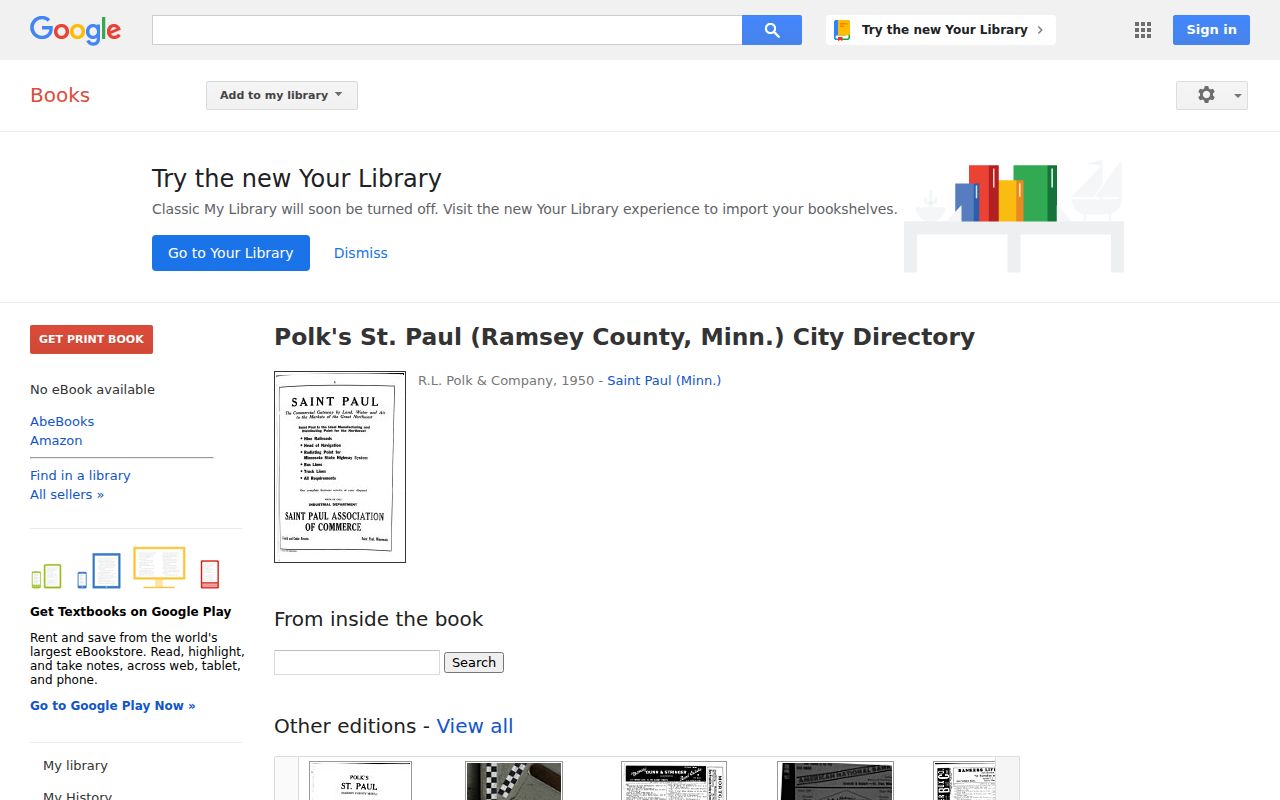
The scan demonstrates the compact column format a researcher should expect, while the surrounding volume and an archival request supply the context a cropped entry cannot show.
White Bear Lake Archive Shelves and Catalogs
Online search and local shelves answer different questions. WBLAHS has an online genealogical newspaper index for 1887 through 1988, census spreadsheets, and old-to-new as well as new-to-old 1980s building-renumbering references. Its collection database is transitioning to MNCollections and adds material over time. A failed name search there does not establish that a photograph, newspaper reel, minute book, or directory companion never existed.
The reference library at the White Bear Lake Armory holds the deeper local files: newspapers, church and cemetery material, organization records, plats, minutes, and address or census spreadsheets. Many holdings are off-site, the research library is by appointment, self-directed onsite research has no fee, and staff research can carry a fee. Email or call WBLAHS before a visit, especially when looking for an exact volume or a large-format map. Ramsey County Library's White Bear Lake branch is a useful public-computing and scanning stop, but it should not be assumed to hold every local-history item.
Minnesota Historical Society is the statewide backstop for its People Records Search, catalogs, newspapers, directories, and county finding aids. Its online records screen is helpful for pairing historical directory leads with indexed events, but the image does not replace a local directory volume or its abbreviation key.
The Minnesota Historical Society People Records Search provides another research route beside White Bear Lake city directory material.
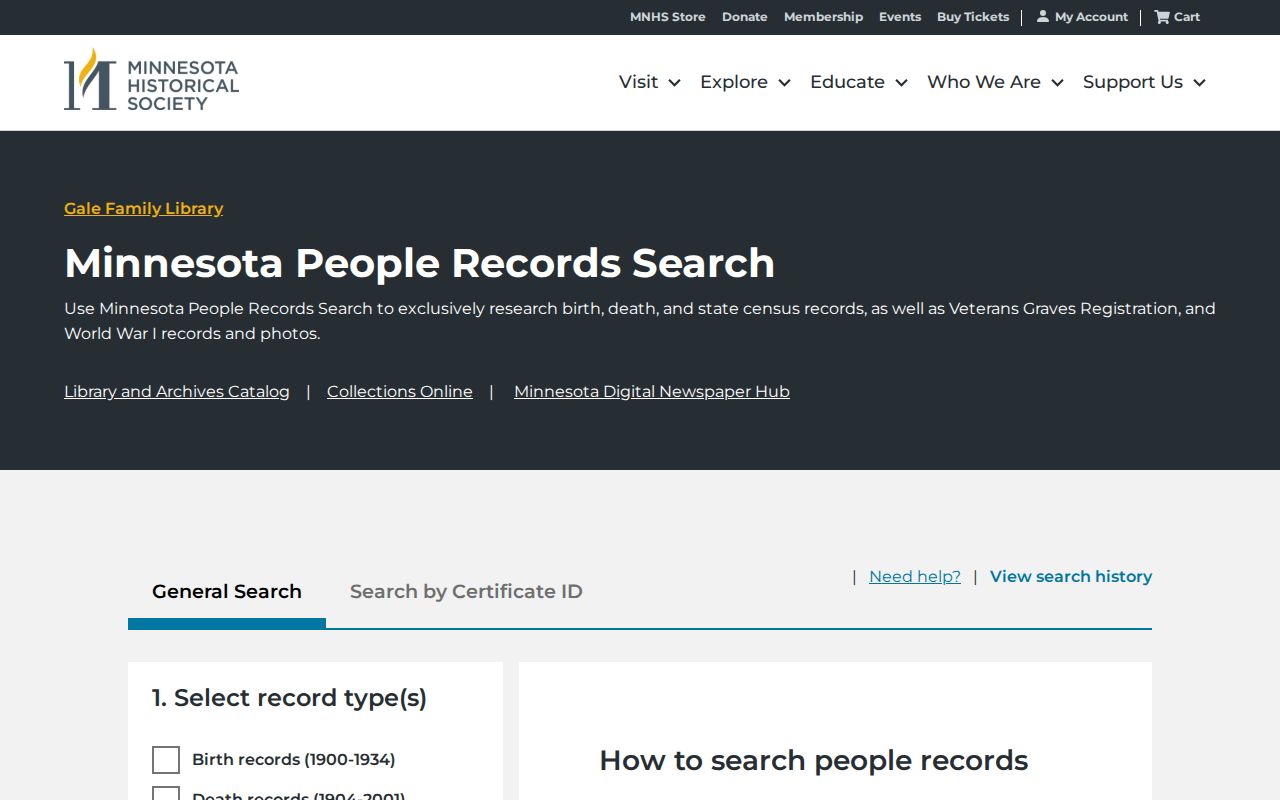
Use the statewide search to identify a dated record, then return to the White Bear Lake directory, newspaper, or local collection that can place that person in the community.
Reading a White Bear Lake City Directory
A directory is an edited snapshot, not a modern database. In the 1950 Polk scan, the useful clues are the arrangement and conventions rather than an implied complete resident list. Names, address fragments, occupation abbreviations, employer references, spouse or relationship indications, and historical widow notation can appear together. Record exactly what the printed line says, including initials and street spelling. Do not silently turn an address into a claim of ownership or a spouse clue into a current family relationship.
| Name | Alphabetical entry and initials, useful for separating same-surname households. |
|---|---|
| Residence | Street address, room, apartment, corner, or area clue when printed. |
| Occupation | Short forms such as acct, bkpr, carp, mech, pntr, slsmn, sten, supvr, or wldr may appear. |
| Household clue | Spouse or relationship language and historical widow notation may appear, depending on the edition. |
| Street section | Street or area headings help orientation; an address-to-name reverse section must be verified in the volume. |
- City directory
- A dated publication that organizes residents, businesses, and addresses according to its own editorial scope.
- Reverse or criss-cross section
- An address-order index that can point back to an occupant or business. It is not guaranteed in every directory.
- Abbreviation key
- The volume's guide to the shortened words and marks used in entries. Photograph or transcribe it before interpreting a line.
White Bear Lake Directory Clues in Print
Local newspapers fill the gaps between the few confirmed directory leads. The Lake Breeze first appeared on May 7, 1887. WBLAHS preserves microfilm under the Lake Breeze, Breeze, White Bear Life, White Bear Press, Free Press, Railsplitter, and Town Crier titles through 2005. Its 1887-1988 genealogical index can direct a reader to notices, obituaries, club reports, property sales, and other dated mentions that make a directory entry more useful.
| May 7, 1887 | The Lake Breeze begins publication. |
|---|---|
| 1887-1988 | WBLAHS maintains its online genealogical newspaper index. |
| 1950 | Verified R.L. Polk St. Paul and Ramsey County directory with White Bear Lake searchable text. |
| 1958-1960 | St. Paul North Suburban reels list White Bear Lake in their coverage. |
| 1887-2005 | WBLAHS microfilm titles provide a longer local print trail. |
A notice is a dated clue, not an automatic address confirmation. Pair it with the directory year, the correct street name, and, when useful, the local address-renumbering index. Washington Avenue was once Railroad Avenue, so an older listing can be missed if only its present name is searched.
Tracing White Bear Lake Directory Households
A household trail gains strength when each source answers a separate question. Start with a dated newspaper item, census row, deed, or directory entry. Copy the printed name, address, and every qualifier. Search nearby directory years rather than leaping across a long gap. A moved address, a changed occupation, or a widow indicator can suggest where to look next, but it does not itself prove why the household changed.
- Choose a year tied to a known White Bear Lake event, address, or census household.
- Record the directory spelling, initials, residence, occupation wording, and any relationship notation.
- Check one or two nearby confirmed directory years or the North Suburban reel period for a move or repeat listing.
- Verify whether that edition contains a reverse section before attempting an address-to-name search.
- Pair the result with the appropriate federal or Minnesota census and the WBLAHS newspaper index.
- Use a deed, permit, obituary, cemetery index, or church record only for the separate fact it can support.
For an address changed in the 1980s, use WBLAHS's two-way renumbering cross-reference before joining an older directory to a current parcel. A disappearing name might mean a move, death, an unlisted line, a different jurisdiction label, or simply an edition that did not cover the household. The sound approach is to test those possibilities with the next record, not to choose one.
White Bear Lake Directory Census Labels
White Bear Lake history changes the labels a researcher needs to test. WBLAHS census spreadsheets separate White Bear Township, Village of White Bear, City of White Bear Lake, Birchwood, Dellwood, and Lincoln Township. The local files include White Bear Township sets from 1860 through 1930, Village of White Bear sets for several years beginning in 1880, and City of White Bear Lake material for 1930. A surname that seems absent can be filed under a different political unit rather than lost.
That geography also explains the value of the regional Polk and North Suburban publications. White Bear Township organized in 1858, the Village of White Bear existed from 1881 to 1921, and later municipal changes altered the record landscape. Search the printed locality heading as carefully as the surname. When a result is near the city boundary, confirm the parcel's county and legal municipality instead of relying only on the White Bear Lake mailing description.
White Bear Lake City Directory Gaps
The public research does not verify the first or last year of a White Bear Lake-only city directory, a complete local shelf run, or a reverse-directory run. Those are catalog questions to ask, not blanks to fill with a guessed range. MNHS can be asked specifically for St. Paul North Suburban and Ramsey volumes, while WBLAHS can be asked whether an off-site item, telephone directory, local business list, or address file bridges a missing year.
Some collections are only partially cataloged during the move to MNCollections. Save the surname variants, address, decade, old street name, and intended record type before making an appointment. That focused request helps staff check the Armory reference shelves, off-site storage, and the newspaper or census tools without treating an online catalog as the whole collection.
White Bear Lake City Directory Research Desk
For local material, begin with WBLAHS Online Research, then contact the Armory reference library at 2228 Fourth Street or 651-407-5327 before traveling. Its online index, 1860-1930 census sheets, and old/new address files are practical first checks. The society serves White Bear Lake, White Bear Township, Birchwood, Dellwood, and Mahtomedi, so state the exact community label as well as the surname.
For a statewide or regional search, use the MNHS city-directory and telephone-book request route and ask for the confirmed Polk 1950 volume or the 1958-1960 North Suburban reels. Bring an exact decade, street spellings, and any address conversion with you. A directory is often the middle of a research trail: local newspapers, minute books, plats, church and cemetery records, and census material can supply the beginning or endpoint that a directory alone cannot.